How a Simple Piece of Metal Became a High-Tech Device
Have you ever wondered how a car starts? You sit in your car, press a button and the engine quietly comes to life. You don’t think about it for a moment – it’s just part of everyday life. But have you ever wondered how we got here? How did a simple piece of metal evolve into a complex electronic device that fits in your pocket and can communicate with your car from dozens of metres away?
This is a story of innovation, safety and convenience – the story of the car key. From hand-cranking to entering your car with a smartphone – every era has brought something new and exciting.
🔧 Before Keys: The Hand-Crank Era
When Karl Benz introduced the first practical automobile to the world in 1885 – the Benz Patent-Motorwagen – it had neither an ignition key nor even an electric starter. To get it going, you had to use physical force – crank it by hand. This was not only inconvenient but also dangerous. Many early drivers were injured when the engine kicked back and the crank started spinning uncontrollably. Broken wrists and arms were common.
The first cars were more like toys for the wealthy than practical means of transport. They were noisy, unreliable and required considerable physical strength. But even then, engineers understood that starting a car needed to become simpler and safer.
🔑 The 1910s: The First Ignition Keys
The first major breakthrough came in 1910 when Cadillac introduced the electric starter. This was revolutionary – the driver could now start the car with a simple push of a button. But security was still a problem. Anyone could get into the car and start it – car theft became increasingly common.
The solution came from aviation. Aircraft already had switches that could be locked with a key. Automotive engineers adapted this idea and by the end of the 1910s the first ignition keys began to appear. They were simple – turn the key, the electric current is connected and the starter engages. Security improved noticeably, but keys were still easy to duplicate.

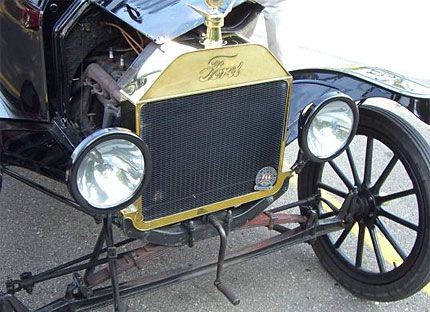
One of the first ignition keys – simple but revolutionary
🏭 1920s–1940s: Standardisation
In the 1920s, cars became increasingly popular. The Ford Model T had made cars accessible to ordinary people. Along with this grew the need for standardised systems. Each manufacturer had their own keys, their own locks and their own systems – meaning one car’s key wouldn’t fit another. Finding spare parts was difficult and expensive.
By the 1930s, ignition keys had become standard equipment. But they were still just pieces of metal that were easy to copy. Security was minimal – it took little skill to pick a lock or duplicate a key. Car owners had to rely mainly on their car not attracting the attention of thieves.
🚗 1950s–1960s: The Golden Age of Design
After the Second World War, the automotive industry began to flourish. Cars became more powerful, faster and – most importantly – more stylish. Manufacturers like Cadillac, Buick and Oldsmobile began to create car keys that were themselves small works of art. The car key was no longer just a functional object – it was a symbol of style and status.
In the 1950s, a New York company called Signa-Craft created the first “flip keys” – knife-shaped keys that could be folded. They were inspired by jackknives and were considered very fashionable. At the same time, other manufacturers like Curtis and Taylor Locks began producing so-called “Crest Keys” – keys with an enamelled rendition of the car manufacturer’s logo, plated in 14-karat gold.
These golden keys became so popular that even oil companies like Mobil and Texaco began issuing them as promotional gifts for customers. Today these early golden keys are highly sought after by collectors – some are worth thousands of euros. This shows how far car culture has evolved.
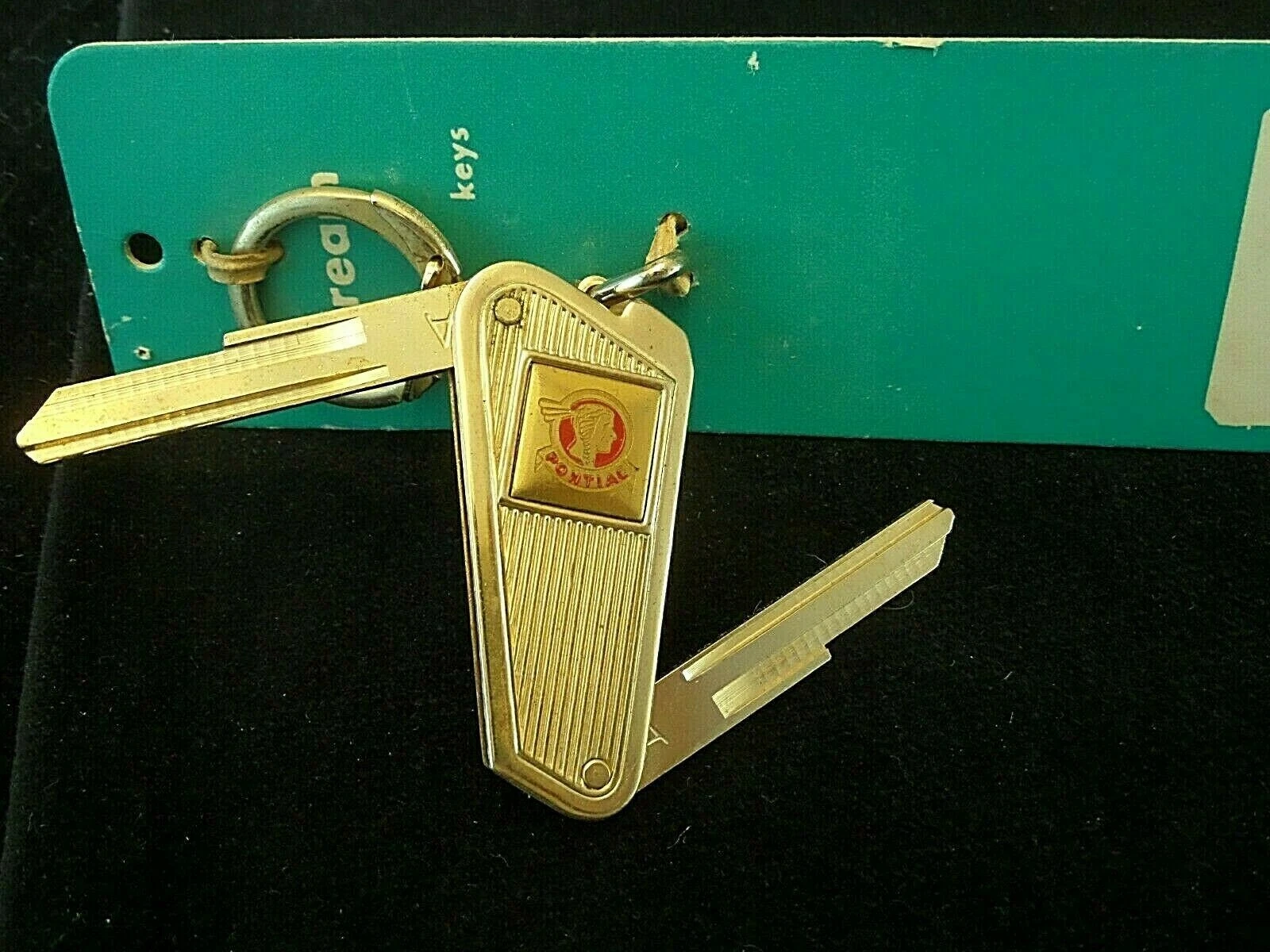
Signa-Craft’s first “flip key” – a foldable knife-shaped key
🔐 1980s–1990s: The Security Revolution
By the 1980s, car thieves’ ingenuity had grown. Simple metal keys were easy to copy and locks easy to pick. Manufacturers needed a new solution and found it in electronics. At first people were sceptical – could electronics really offer better security than a traditional mechanical lock?
In the early 1990s, transponder technology was introduced. A small chip was placed inside the key that communicated with the car’s computer. If the chip didn’t send the correct code, the engine wouldn’t start – even if the key physically fit the lock. It was a brilliant solution: a thief could pick the door lock, but without the right chip they could never start the car. Every time the driver turned the key, a complex data exchange occurred between the key and the car within milliseconds.
This technology made car theft dramatically more difficult. Statisticians noticed that thefts of transponder-equipped cars dropped by up to 70 percent. Insurance companies began offering discounts for cars with transponders. But there was a downside: making a new key became significantly more expensive. Where a spare key used to cost a few euros, it could now run into hundreds of euros.
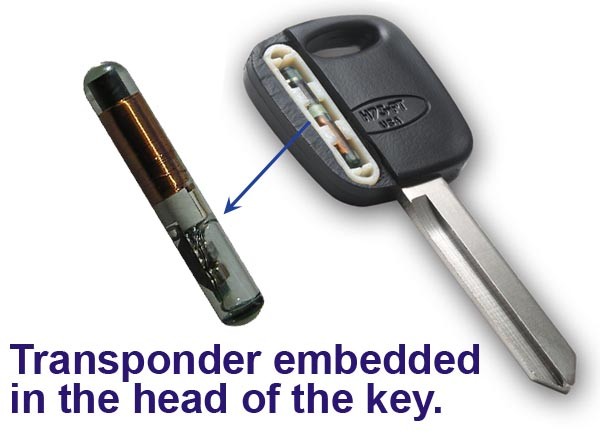
Transponder-tehnoloogiaga autovõti – sees on näha elektrooniline kiip (Allikas: Wikimedia Commons)
📱 2000. aastad: Kaugjuhtimispuldi ajastu
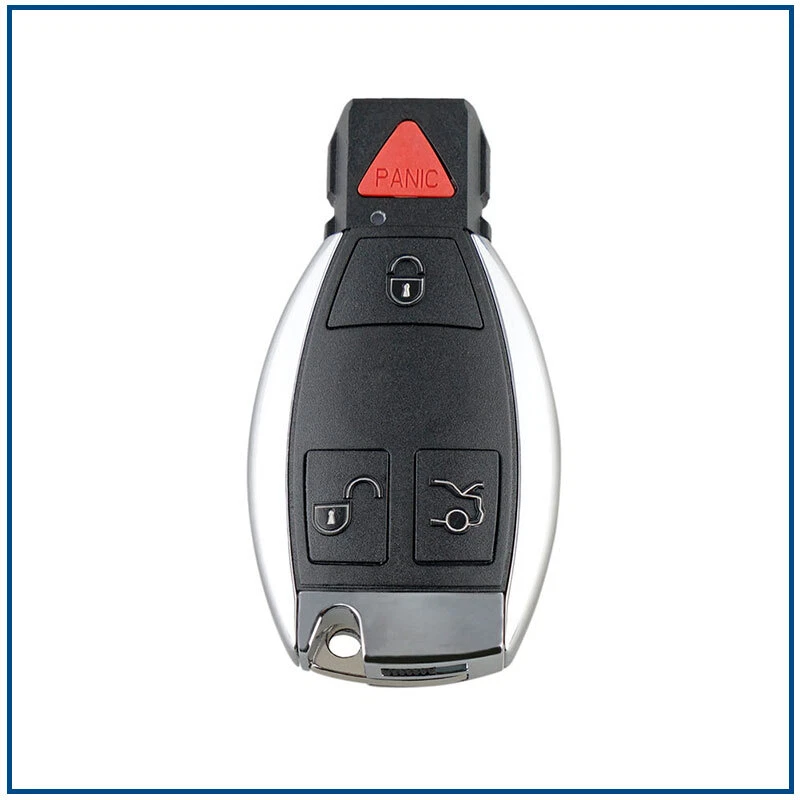
Remote-controlled locking had existed since the 1980s, but in the 2000s this functionality began to grow explosively. Keys no longer just opened doors – they could open the boot, turn on interior lighting, adjust seats and even start the engine from a distance. Convenience that previous generations could only dream of.
General Motors was the first to offer factory-installed remote start in 2004. This was especially popular in cold climates – you could drink coffee in the kitchen in the morning while your car warmed up. In Nordic countries, including Estonia, it quickly became one of the most sought-after optional extras.
🎮 The 2010s and Today: The Smart Future
In 2016, BMW shocked the world when it unveiled its 7 Series model with a key that looked more like a smartphone than a car key. It had a touch-sensitive screen, could park the car autonomously and could be used to control the climate system. James Bond would have been jealous – technology that previously only existed in films was now reality.
In 2019, Hyundai went even further. Their “Digital Key” technology allowed a smartphone to be used as a car key. Using NFC technology, the driver could unlock and start the car without even taking their phone out of their pocket. Through the app, the owner could grant access to other family members and specify how long and when they could use the car. This is especially useful for families where several people share one car.
Tesla has taken things even further. Their cars use Bluetooth and location-based recognition – a phone or a special card is all you need. The car recognises you before you even reach the door. The seat, steering wheel and mirrors automatically adjust to your preferences. This is personalisation at a whole new level.

💡 Interesting Fact: Did you know that today, replacing a car key often requires connecting a computer? A key can no longer simply be “cut additionally” – it must be programmed with a special diagnostic device. Lukuabi 24/7 specialists do this work every day in both Tartu and Valga, using professional equipment.
🔮 What Does the Future Hold?
Development continues and boundaries are blurring more and more. Several manufacturers are already testing biometric solutions – fingerprint readers, voice recognition and even facial recognition. Imagine: you approach your car, it recognises your face, opens the door and adjusts all settings automatically. Perhaps the day is not far off when the physical key becomes as obsolete as the horse-drawn carriage.
However, these developments also raise important questions. What happens if your phone runs out of battery? What do you do if the biometric system doesn’t recognise you? How do you protect yourself from hackers who might try to break into your car’s electronic system? These are questions to which car manufacturers are still searching for answers.
But one thing is certain: regardless of all the technology, there will always be a need for professional help when a key is lost, broken or needs programming. Lukuabi 24/7 is here to help – whether it’s the most modern digital key or a good old metal one. Our specialists are up to date with the latest technologies and can help with any make and model.
Need help with your car key? Call +372 56 722 344 or visit us in Tartu (Kalda tee 43) or Valga (Vabaduse tn 36a).